MARK C. STEVENSON
UPON further
REFLECTION
MEMORY • A NARRATIVE ACCUMULATION
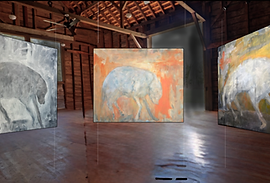
Upon Further Reflection is an installation that explores how memory functions more like oral tradition than written record: a story reshaped by each retelling in response to current experience. The work attempts to embody that process rather than illustrate it.
The work consists of seven* 48 × 60-inch paintings suspended at eye-hight to form an inward-facing circle. Visitors enter between the gaps.



THE PAINTINGS
Each painting begins by scrubbing out the image of a dog from a solid monotone ground, then progresses through a sequence of techniques guided by simple rules:
-
The source material is never revisited.
-
Each painting applies the same techniques, in the same order, as all that precede it.
-
A “finished” work cannot be changed.
-
New paintings address newly discovered unfinished business.
-
Technically, there is no end to the series (see rule 4).
Following these rules, each work is a record of the forces shaping its outcome: memory of previous works, knowledge gained through repetition, and intention guiding what comes next. In this way, the process mirrors how memory is repeatedly rebuilt through the interaction of previous recollections, present circumstances, and expectations about the future.
THE INSTALLATION
From outside, Upon Further Reflection reads as a contained object. The exposed canvas backs, stretcher bars, and suspension structure reveal its physical construction. Visitors enter the circle through gaps between the paintings, crossing from the exterior structure into an interior surrounded by accumulated versions of the remembered image.
There is no designated entrance, first painting, or prescribed direction of travel. The first image encountered is determined by each visitor’s choice and physical position rather than an imposed chronology. No single painting has a first claim on the “truth.” Inside the circle, multiple versions of the same remembered subject remain simultaneously valid.
Upon Further Reflection is an installation that explores how memory functions more like oral tradition than written record: a story reshaped by each retelling in response to current experience. The work attempts to embody that process rather than illustrate it.
The work consists of seven* 48 × 60-inch paintings suspended at eye-hight to form an inward-facing circle. Visitors enter between the gaps.
THE PAINTINGS
Each painting begins by scrubbing out the image of a dog from a solid monotone ground, then progresses through a sequence of techniques guided by simple rules:
-
The source material is never revisited.
-
Each painting applies the same techniques, in the same order, as all that precede it.
-
A “finished” work cannot be changed.
-
New paintings address newly discovered unfinished business.
-
Technically, there is no end to the series (see rule 4).
Following these rules, each work is a record of the forces shaping its outcome: memory of previous works, knowledge gained through repetition, and intention guiding what comes next. In this way, the process mirrors how memory is repeatedly rebuilt through the interaction of previous recollections, present circumstances, and expectations about the future.
THE INSTALLATION
From outside, Upon Further Reflection reads as a contained object. The exposed canvas backs, stretcher bars, and suspension structure reveal its physical construction. Visitors enter the circle through gaps between the paintings, crossing from the exterior structure into an interior surrounded by accumulated versions of the remembered image.
There is no designated entrance, first painting, or prescribed direction of travel. The first image encountered is determined by each visitor’s choice and physical position rather than an imposed chronology. No single painting has a first claim on the “truth.” Inside the circle, multiple versions of the same remembered subject remain simultaneously valid.